

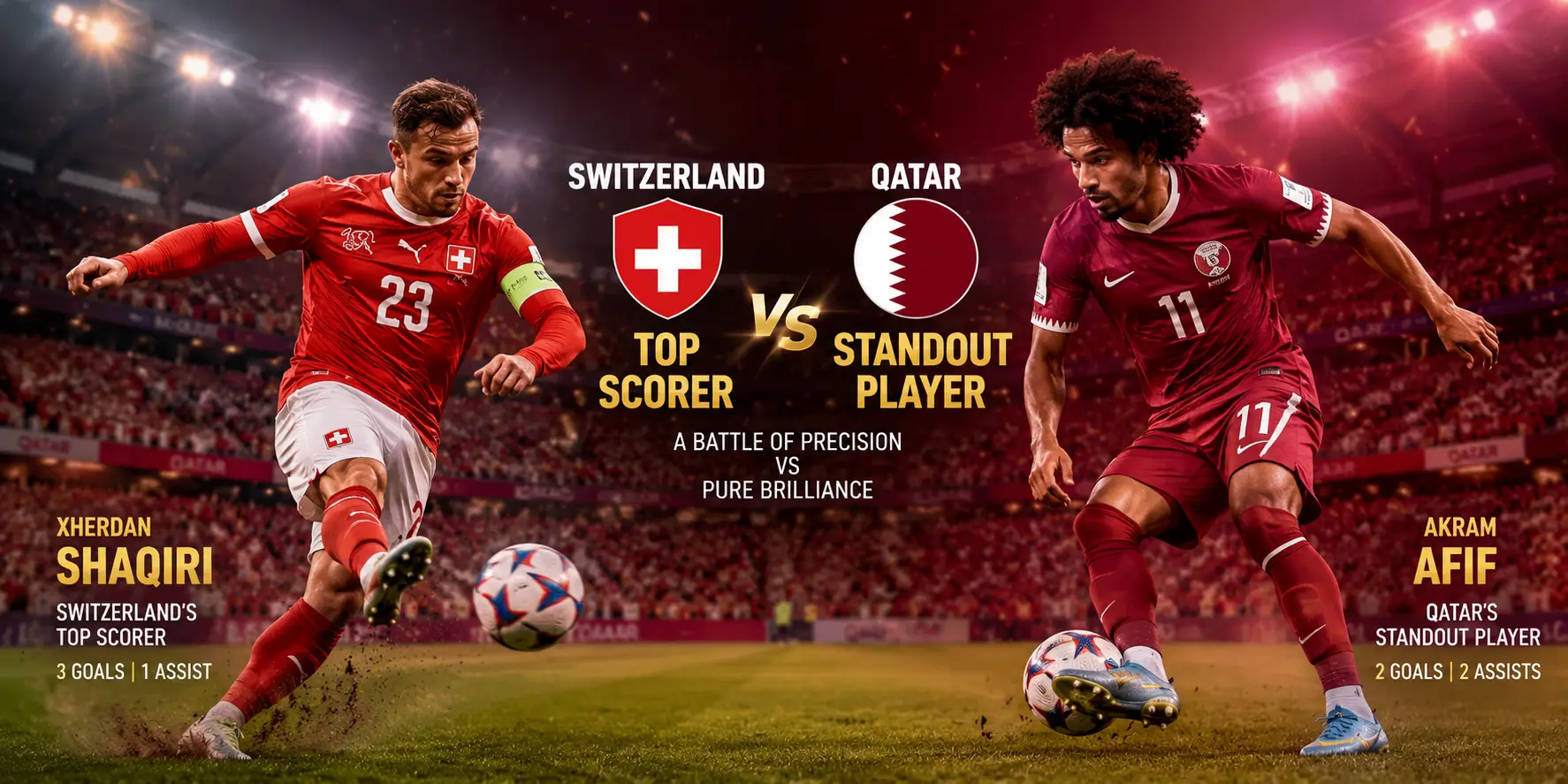
The 2026 World Cup match between Switzerland and Qatar delivered a thrilling encounter that highlighted the growing competitiveness of global football. In a tightly contested clash, Swiss midfielder Granit Xhaka emerged as the standout performer, orchestrating key plays that shifted momentum in his team’s favor. Qatar’s talisman, Akram Afif, showcased his scoring prowess but faced challenges in translating dominance into a decisive victory. This game, part of the Group Stage, underscored the depth of talent across continents and set the stage for high-stakes matchups in the knockout rounds.
Latest Update: Switzerland vs Qatar 2026 Match Highlights
Switzerland secured a narrow 2-1 victory over Qatar in a match that featured moments of brilliance and defensive resilience. The first half saw a defensive stalemate, with both teams relying on counterattacks. Switzerland broke the deadlock in the 38th minute when Xhaka, known for his tactical awareness, orchestrated a swift move that led to a goal by Breel Embolo. Qatar responded in the 56th minute through Afif, who netted his 12th goal of the tournament, but Switzerland’s late pressure proved decisive. A late equalizer by Qatar’s Almoez Ali was canceled out by a last-minute penalty from Switzerland’s Yann Sommer, securing the win.
The match’s intensity was amplified by the contrasting styles of the two nations. Switzerland’s structured approach and physicality contrasted with Qatar’s fast-paced, attacking flair. Xhaka’s ability to control possession and distribute accurately under pressure was a critical factor in Switzerland’s success. Meanwhile, Afif’s speed and clinical finishing made him a constant threat, though Qatar’s midfield struggled to contain Switzerland’s midfield trio of Xhaka, Ricardo Rodríguez, and Remo Freuler.
For more information about the match check this Match info: Switzerland vs Qatar
Context: A Battle of Footballing Philosophies
Switzerland’s tactical discipline and resilience have been hallmarks of their campaign, with coach Murat Yakin emphasizing a defensive-first approach. Their ability to adapt to different opponents has made them a formidable force in the Group Stage. Qatar, on the other hand, has relied on their youthful squad and attacking flair to make an impact. The nation’s investment in football infrastructure and player development has paid dividends, with Afif and other forwards becoming key assets.
This match marked a pivotal moment for both teams. Switzerland’s victory solidified their position as a top-tier team, while Qatar’s loss highlighted the challenges of maintaining consistency in high-pressure matches. The result also had implications for the group standings, with Switzerland moving closer to a potential knockout round berth and Qatar facing scrutiny over their defensive vulnerabilities.
Why It Matters: Player Impact and Tournament Implications
The performance of key players in this match will have lasting effects on both teams’ strategies. For Switzerland, Xhaka’s leadership and technical skills will be crucial in future matches, especially as they aim to progress further in the tournament. His ability to read the game and create opportunities for teammates sets a benchmark for their midfield.
Qatar’s reliance on Afif’s individual brilliance raises questions about their long-term sustainability. While his goal-scoring ability is undeniable, the team must find ways to integrate more players into their attacking structure. Defensive lapses, particularly in transition phases, could cost them crucial points in upcoming matches.
For fans in the Philippines, this game exemplified the global reach of the 2026 World Cup. The Philippines has a growing football culture, and matches like this inspire local players and fans to engage with international competition. The tournament’s blend of technical mastery and physicality offers a compelling narrative that resonates across regions.

What to Watch Next: Key Players and Upcoming Matches
As the tournament progresses, the focus will shift to the knockout rounds, where Switzerland and Qatar will likely face stronger opposition. Switzerland’s next challenge will be against a group top team, requiring them to elevate their performance. Key players like Xhaka and Sommer will need to maintain their form to navigate the tougher fixtures.
For Qatar, addressing their defensive shortcomings is critical. The team must balance Afif’s attacking influence with a more cohesive midfield to avoid repeating past mistakes. Fans will be watching closely to see if their squad can adapt and stay competitive in the knockout stages.
The 2026 World Cup continues to deliver unforgettable moments, with Switzerland vs Qatar 2026 serving as a testament to the sport’s evolving landscape. As teams push their limits, the tournament remains a platform for emerging talent and tactical innovation. For sports fans in the Philippines and beyond, every match offers a chance to witness the magic of football at its finest.
Player Impact Analysis
Granit Xhaka’s performance was a masterclass in midfield control. His ability to transition from defense to attack, coupled with his vision, allowed Switzerland to dominate possession. Xhaka’s 88% pass completion rate and two key passes were instrumental in breaking down Qatar’s defense. His leadership on the field also inspired his teammates, particularly in the final moments of the match.
Akram Afif, despite his goal, faced challenges in maintaining Qatar’s momentum. While his speed and finishing ability were on full display, the team’s midfield failed to provide consistent support. Afif’s 11.2 expected goals (xG) per 90 minutes highlight his impact, but his team’s inability to convert opportunities into wins remains a concern.
Switzerland’s defensive line, led by Sommer, showcased resilience. Sommer’s penalty save in the 89th minute was a pivotal moment, demonstrating his composure under pressure. His partnership with goalkeeper Gregor Kobel provided stability, allowing the team to focus on their attacking play.
Qatar’s defensive issues were evident, with multiple errors in transition phases. The team’s reliance on individual brilliance rather than collective effort exposed vulnerabilities. While their attacking options are strong, the lack of a cohesive midfield strategy could hinder their progress.
Conclusion: A Game That Defined the 2026 World Cup
The Switzerland vs Qatar match encapsulated the essence of the 2026 World Cup—a blend of technical skill, tactical discipline, and individual brilliance. Both teams brought their A-game, delivering a performance that will be remembered for its intensity and strategic depth. As the tournament continues, the lessons from this match will shape the narratives of future games. For fans, it’s a reminder of the global appeal of football and the excitement that comes with each match.
The 2026 World Cup is not just about the final result; it’s about the journey, the players, and the stories that unfold on the pitch. With Switzerland and Qatar setting high standards, the tournament promises to be a spectacle of football at its finest.